
Mindfulness and Intimacy: How Intentional Solo and Partner Play Can Anchor a Real Self-Care Routine

Most self-care routines look roughly the same: a morning meditation, a gratitude journal, maybe a face mask on Sunday. They're all fine. But there's a whole category of body-aware, nervous-system-resetting practice that almost nobody talks about in the same breath as wellness — and it's one of the most direct routes to genuine presence you can find.
Intentional intimate play — solo or with a partner — isn't a guilty pleasure you fit in around your real self-care. For a lot of people, it is the self-care. The science backs this up: sexual arousal and orgasm trigger a cascade of neurochemical activity including oxytocin and dopamine release, and the focused body attention required during intimate moments is, by definition, mindfulness in action. Your mind can't wander to tomorrow's inbox when you're fully tuned into physical sensation.
The problem isn't that people don't know this intuitively. The problem is that nobody gives them a framework for approaching it with the same intentionality they'd bring to a yoga session or a breathwork class.
What Makes Something a Mindfulness Practice?
Mindfulness, at its core, is sustained, non-judgmental attention to present-moment experience. That's it. A breathing exercise earns that label because it asks you to notice — really notice — what's happening in your body right now, without drifting into planning or ruminating.
Intimate play, done with intention, checks every one of those boxes. It demands physical presence. It surfaces body sensations you'd normally tune out. It interrupts the stress-loop of mental chatter more effectively than most seated meditation practices, because the body's arousal response actively competes with anxious thought. The challenge isn't whether it qualifies — it's whether you approach it with the same deliberateness you'd bring to any other practice.
Rushed, distracted, or guilt-laden intimate moments don't deliver the same reset. The mindfulness is in the intention, not just the act.
The Honest Case for Solo Practice
Solo play is often framed as a consolation prize — something you do when a partner isn't available. That framing is worth discarding entirely. Solo intimate practice is one of the clearest forms of self-directed body literacy available to adults. You learn what you actually respond to, without the noise of another person's expectations or your own performance anxiety.
Approached mindfully, a solo session becomes a body-scan with stakes. You're not just going through the motions — you're noticing which sensations you've been ignoring, where you're holding tension, what your nervous system actually needs today versus what it needed last week. That kind of self-knowledge compounds over time in ways a weekly meditation class rarely does.
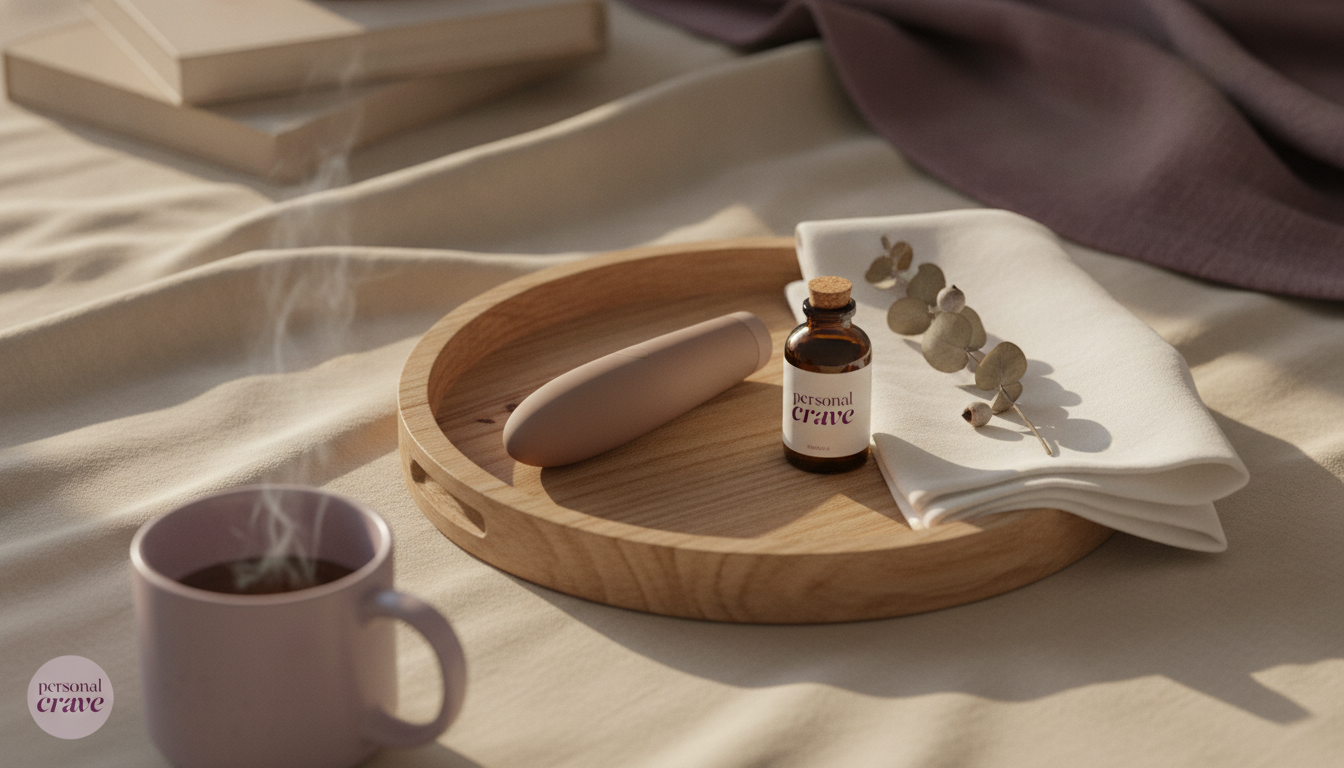
The practical shift is small but meaningful: put your phone in another room, give yourself a set window of unhurried time, and approach it as you would a restorative yoga class — with curiosity rather than a goal. The right tool helps. A quality body-safe vibrator removes friction (literally and figuratively) and lets you stay in your body rather than in your head.
Building It Into a Weekly Routine (Without Overthinking It)
You don't need a ritual. You need a rhythm. Here's a simple framework that works whether you're practicing solo or with a partner:
- Protect the time. Block it the same way you'd block a workout. Even one intentional session a week, held consistently, has a different quality than something that only happens when everything else is done. It rarely happens if you wait for that moment.
- Create a transition. A five-minute wind-down before — dimming lights, putting on music, a few slow breaths — signals to your nervous system that this time is different from the rest of the day. It's the equivalent of rolling out a yoga mat: a physical cue that shifts your mode.
- Set a single intention, not a goal. "I want to feel more relaxed" is an intention. "I need to orgasm" is a goal. Goals create performance pressure; intentions create presence. The difference in experience is significant.
- Stay with sensation, not narrative. When your mind starts drafting the grocery list, gently return attention to physical sensation — temperature, pressure, rhythm. This is the rep. Every return is the practice working.
- Give yourself a genuine close. Don't immediately reach for your phone. A few minutes of stillness afterward — just lying quietly — lets the nervous system actually integrate the reset instead of immediately re-entering stimulation mode.
For Partners: Shared Presence Is Its Own Practice
Couples who approach intimacy with intention often report that the quality of connection changes more than the frequency does. When both people are genuinely present — not performing, not distracted, not rushing toward an endpoint — the intimacy becomes something closer to co-regulation: two nervous systems synchronizing rather than two people going through familiar motions.
A few things that support this in practice: slow down the pace deliberately, especially at the start. Make eye contact. Narrate what you're noticing — "this feels good" said out loud keeps both people anchored in the present moment. And don't underestimate the value of a new sensory input to break autopilot. Introducing a couples toy, experimenting with a new type of sensation, or simply changing the setting can interrupt the habitual pattern enough to bring both people back into genuine attention.
If communication is the sticking point — and for many couples it is — building that muscle outside the bedroom first makes a real difference. Our post on enhancing intimacy through conversation covers some practical ways to do that.
The Role of Body-Safe Products in a Mindful Practice
This matters more than most people realize. If you're trying to stay present in your body, the last thing you want is a background worry about what a product is made of. Non-body-safe materials — certain plastics, porous rubbers — can harbor bacteria and cause irritation, which is a real and legitimate concern, not a marketing talking point.
Body-safe silicone, glass, and stainless steel are the materials worth looking for. They're non-porous, easy to clean, and don't interfere with the body's natural chemistry. If you're not sure what to look for, our guide on body-safe silicone breaks it down clearly. When you're not worried about what something is made of, you can actually stay in the moment — which is the whole point.
Lubrication is similarly underrated as a mindfulness tool. Discomfort pulls you out of presence immediately. A quality lubricant removes that friction and lets sensation stay the focus. If you're navigating sensitive skin or just want to understand your options, this breakdown of lubricant types is worth a read before you choose.
One Reframe Worth Keeping
The wellness industry has spent years telling people that self-care looks like a specific set of products and practices — most of them photogenic, most of them quiet, most of them slightly ascetic. That framing leaves out one of the most direct, most embodied, most human forms of self-care available.
Intentional intimacy — with yourself or a partner — is not a break from your wellness routine. For a lot of people, it's the part of the routine that actually works.
Ready to build it in? Explore the full range of body-safe vibrators and couples toys at PersonalCrave — every order ships in plain, unbranded packaging, so your practice stays as private as it should be.
Frequently Asked Questions
Is solo intimate play really considered a mindfulness practice?
Yes — by the standard definition of mindfulness (sustained, non-judgmental attention to present-moment experience), intentional solo play qualifies. The key word is intentional. Approached with presence and curiosity rather than distraction or goal-fixation, it asks exactly the same thing of your attention as a body-scan meditation does.
How often should I practice intentional intimacy as part of a self-care routine?
There's no universal prescription — consistency matters more than frequency. One genuinely unhurried, intentional session per week tends to be more valuable than several rushed ones. Start with whatever feels sustainable and adjust from there based on how you feel.
What's the difference between body-safe and non-body-safe sex toys?
Body-safe materials — like medical-grade silicone, borosilicate glass, and stainless steel — are non-porous, meaning they don't harbor bacteria and are easy to clean thoroughly. Some cheaper toys use porous plastics or rubbers that can trap bacteria even after washing and may cause irritation. Our guide to body-safe silicone covers exactly what to look for.
How does PersonalCrave handle packaging — will anyone know what I ordered?
Every order from PersonalCrave ships in plain, unbranded packaging with no product names, logos, or any indication of what's inside. The billing descriptor is also discreet. Your practice is yours — the packaging reflects that.